
NSG 6435 Final Exam
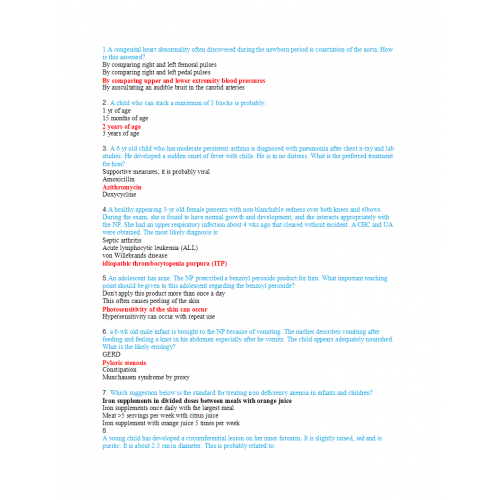
1.A congenital heart abnormality often discovered during the newborn period is coarctation of the aorta. How is this assessed?
2. A child who can stack a maximum of 5 blocks is probably:
3. A 6 yr old child who has moderate persistent asthma is diagnosed with pneumonia after chest x-ray and lab studies. He developed a sudden onset of fever with chills. He is in no distress. What is the preferred treatment for him?
4.A healthy appearing 3-yr old female presents with non-blanchable redness over both knees and elbows. During the exam, she is found to have normal growth and development, and she interacts appropriately with the NP. She had an upper respiratory infection about 4 wks ago that cleared without incident. A CBC and UA were obtained. The most likely diagnosis is:
5.An adolescent has acne. The NP prescribed a benzoyl peroxide product for him. What important teaching point should be given to this adolescent regarding the benzoyl peroxide?
6. a 6-wk old male infant is brought to the NP because of vomiting. The mother describes vomiting after feeding and feeling a knot in his abdomen especially after he vomits. The child appears adequately nourished. What is the likely etiology?
7. Which suggestion below is the standard for treating iron deficiency anemia in infants and children?
8. A young child has developed a circumferential lesion on her inner forearm. It is slightly raised, red and is puritic. It is about 2.5 cm in diameter. This is probably related to:
9. A 7-yr old entered clinic 1 month ago. There was no evidence that he had any immunizations. He was given the vaccinations listed on his vaccination record at the time of his visit. if he returns today, which immunizations can he receive?
10. What would be appropriate anticipatory guidance for the parent of a 9-month old infant?
11. An infant is diagnosed with diaper dermatitis. Satelite lesions are visible. This should be treated with a:
12.The NP sees a child who reports fatigue and presents with purpura on his lower extremities. His temperature is normal. The differential includes:
13.Genetics
14. Nutrition
15. Height, Skin, Hair, Eye color
16. Growth
17. Development
18. Teratogen
19. Autocratic
20. Patriarchal
21. Matriarchal
22. Democratic
23. Nuclear family
24. Social contract and cohabitation
25.Single parent family
26. Blended ( reconstituted)
27. Erick Erickson
28. Sigmond Freud
29.Jean Piaget
30. Extended family
31. Homosexual
32. Adoptive
33. Gradfamilies
34. Foster
35. Basic trust v mistrust
36. Autonomy v shame and doubt
37. Initiative v guilt
38. Industry v inferiority
39. Identity v role confusion
40. Intimacy v isolation
41. Generativity v stagnation
42. Ego integrity v despair
43. Mood swings
44. male- Tanner stage I
45.Male-Tanner stage 4
46. earliest age child able to copy triangle, know colors and count on fingers
47. earliest age avg child would appropriately receive paper and scissors with rounded points
48. usual age for vision screening
49. female Tanner stage 4
50. Female - Tanner stage 5
51. 14 yr old male- acute painless swelling of groin. which tool will yield the most info
52. Age of precocious puberty
53. avg age of pubertal growth spurt in american boys
54. Female - Tanner stage II
55. 12 yr old male, hip pain w/ activitiy, worsening, involves knee, no trauma, ?In office eval?
56. Trendelenburg test used to id
57. what age should oral health risk assessment begin?
58. 4 yr child not allergic to chickens but allergic to duck feathers, immunizations contraindicated?
59. child can walk backwards
60. child can stand on one foot
61. Can stack 5 blocks
62. child can stack 3 blocks
63. Positive support reflex ceases after
64. In school aged child (6-12)___considered tachycardia
65. Normal heart rate 60-100 after age
66. Male-First sign of sexual maturation
67. Male- average age of sexual maturation
68. delayed puberty
69. Most common cause of delayed puberty
70. to eval for hip dysplasia
71. 6mo male-palpable cystic mass in scrotum, size varies
72. 6 mo- disconjugate gaze- tilts head when looking at object
73. Should be avoided in ITP
74. Intussception can follow?
75. NOT a sign of congenital hypothyroidism
76. Adolescent -wt loss, chronic diarrhea, anemia, weakness
77. Describe the s/s of small and large VSDs
78. Acynotic heart murmur d/t increased pulmonary flow
79. Pauciarthritis (most common subgroup of juvi-idiopathic arthritis)
80. side effects of ADHD meds
81. Parents/guardian of adolescents should receive health guidance
82. Age of onset of irritable bowel disease
83. characteristics of infant with bronchopulmonary dysplasia
84. child with insulin pump is more likely to experience
85. palpable thrill in L upper sternal border
86. Which heart defect produces a systolic ejection click at the upper left sternal border with a thrill palpated at the upper left sternal border?
87. sit before standing is example of
88. Maternal iron stores are depleted by
89. In adolescents with IBD, it is important to monitor
90. What are important thing to monitor in patient taking corticosteroids to control inflammation in IBD?
91. treatment for Atypical pneumonia
92. Best tools for treating adolescents
93. The adolescent growth spurt is triggered by
94. Best way to screen for gonorrhea - FEMALE
95. Best way to screen for gonorrhea - MALE
96. HPV screening in female
97. Newborns of diabetic mothers are at risk for
98. gardasil results in greater antibody response for adolescents who receive 3 dose series between ages
99. VISION OF 2 YR OLD
100. 13 yr old pt with bone maturity of 10 yrs
101. treatment for delayed puberty
102. Mother voices concern with 3 yr old stuttering
103. Eating disorders
104. Common symptom of ASD (anterior septal defect)
105. Biomedical issues that may create academic performance issues
106. Bipolar disease requires
107. Joe, a 13 year old with asthma, developed a runny nose, coughing and wheezing on expiration. Joe takes Flovent 2 puffs BID. You would suggest he:
108. Janet is a 16 year old with moderate persistant asthma. She takes Advair discus 250/50 one inhalation BID in her green zone.
109. Which of the following medications would be most appropriate to intensify her controller therapy for yellow zone treatment?
110. When completing Beth’s physical exam which would be inconsistent with a dx of asthma?
111. Beth is a 12 year old with suspected asthma. Which of following findings in her hx would support this dx?
112. ASTHMA
113. ASTHMA DDx
114. Asthma Clinical Manifestations
115. Physical Assessement
116. Pulmonary function tests
117. Degrees of Asthma
118. Mild Persistent Asthma-
119. Moderate Persistent/Severe Asthma
120. Diagnose asthma
121. O2 Sats
122. Therapeutic Mgmt
123. Asthma not controlled if:
124. Rescue medications
125. Anticholinergics
126. Inhaled Corticosteroids
127. Inhalers by age group
128. LABA long acting B2 Adrenergic Agonists
129. Which of the following asthma medications contains a blackbox warning for usage in regards to increased risk of asthma-related deaths
130. Long acting medications
131. Metered dose inhaler - AGE?
132. Aerochamber MDI
133. Status Asthmaticus
134. Otitis Externa
135. OE pathogens
136. Otitis externa RX TX
137. Acute Otitis Media- Prevalence/incidence
138. Pathogen Acute Otits Media
139. AOM physical exam
140. Eustachian Tube
Tympanic Membrane
141. Diagnose AOM Physical exam
142. OM with Effusion TX?
143. 1st line Tx AOM
144. AOM tx failure next?
145. Risk factors of Acute Otitis Media include_____, ______ and ____________.
146. Conductive Hearing loss
147. Conductive hearing loss Physical Exam- Weber-Rinne-
148. causes of SensoriNeural inner ear causes
149. Sensori Neural loss Weber Rinne
150. Hordeoleum
151. Management: Hordeolum
152. DDx Hordeolum
153. Chalazion
154. Blepharitis
155. chalazion mgmt
156. Conjuctivitis- RED EYE
157. Conjunctivitis
158. Viral conjuctivitis
159. Allergic Conjunctivitis
160. Gonococcal conjunctivitis
161. Rx Bacterial Conjuctivitis
162. PeriOrbital Cellulitis
163. Orbital Cellulitis Tx
164. MISCELLANEOUS AIRWAY CONSIDERATIONS IN KIDS
165. Pediatric airway
166. Ped Respiratroy Assessment
167. Wet diapers/stools a day
168. Common cold Sx, PE, DDx
169. Complications of the common cold
170. Pharyngitis
171. Bacterial Pharyngitis
172. Group A Strep
173. Bacterial Pharyngitis Ddx
174. Pharyngitis Ddx<3years >6years
175. GAS Rx
176. Allergic Rhinnitis-MGMT RX
177. Sinusitis xrays? CT?
178. Treat Sinusitis
179. Croup- Steeple sign
180. Laryngitis, Laryngotrachetis, Laryngotracheobronchitis, Bacterial tracheitis, Spasmodit Group
181. croup-Viral, Bacterial causes
182. Croup most common in ages______
183. Epiglottitis
184. Bacterial Pneumonia Rx less than 5
185. Bacterial Pneumo greater than 5 years
186. Bacterial Pneumo Hospitialize when?
187. TB Sx
188. Epstein Barr Virus (MONO)
189. Epstein-Barr virus (mono)
190. Mono S/Sx
191. Mono Mgmt
192. Polio vaccine given @
193. •Parents ask the NP why their baby will receive an IM polio injection instead of the oral vaccine. The best response would be:
194. Tetanus DTap
195. whooping cough
196. Hemophilis Influenzae
197. Meningeal signs-- tests
198. Enterovirus- types, routes, incubation shedding
199. Herpangina, Hand foot mouth
200. Herpangina
201. What causes Hand-Foot-Mouth disease?
202. Erythema Infectiosum-Fifth Disease
203. Erythema Infectiosum (fifth disease)
204. 5ths disease Stage1 and 2
205. fifths disease Tx Management
206. ¨The nurse is educating parents re: fifth disease. What explanation takes priority?
207. Lyme dz Tx Rx
208. Kawasaki disease (KD)
209. Kawasaki Disease(KD)
210. ¨Leading cause of Acquired heart disease in children?
211. Kawasaki disease stage 1
212. Kawasaki Dz stage 2 and 3
213. Kawasaki dz Diagnosis
214. Kawasaki rash
215. Hand swelling
216. nonexudative conjuctivitis
217. strawberry tongue
218. A 3 year old with KD is admitted to the hospital for fever. The nurse knows that the following tx will be started to shorten the fever and decrease the risk of complications?
| Institution & Term/Date | |
| Term/Date | South University |
NSG 6435 Final Exam Study Guide 3
- Product Code: 2022
- Availability: In Stock
-
$30.00
Related Products
NSG 6435 Final Exam
$35.00
NSG 6435 Midterm Study Guide
$25.00
NSG 6435 Week 1 Quiz
$9.99
NSG 6435 Week 1 to 10 Quiz
$25.00
NSG 6435 Week 2 Quiz 1
$6.99
NSG 6435 Week 3 Quiz 1
$9.99
NSG 6435 Week 3 Quiz 2
$9.99
NSG 6435 Week 4 Quiz 1
$9.99
NSG 6435 Week 4 Quiz 2
$6.99
NSG 6435 Week 6 Quiz
$9.99
NSG 6435 Week 7 Quiz
$9.99
NSG 6435 Week 8 Quiz
$9.99
NSG 6435 Week 9 Quiz
$5.99